Skip to content
Farm Market News
Web staci
A podcast for Midwesterners
Kyle Kuphal | Staff reporter
kkuphal@pipestonestar.com

Staci Mergenthal, of Lake Benton, is the host of a podcast called “Funeral Potatoes & Wool Mittens.”

Mergenthal started the podcast in December of 2022. She said she chose the name because she wanted something different that people would remember. The funeral potatoes, or cheesy hash browns, represent a comfort and community vibe, she said, and the wool mittens represent the Midwest, cold weather and coziness. In the beginning of her podcast she describes it as “a show for people who embrace the warm and cozy spirit of everyday living in the Midwest.”

Mergenthal has a background in corporate communications and freelance writing for magazines. She’s also done some private baking for individuals, fundraisers and weddings. About 15 years ago, she started a blog as a place to share recipes. She started the podcast because she wanted to listen to one like it and couldn’t find any.

“For all my life, I’ve really just learned to cook and bake and love it from other home bakers and cooks — just everyday people, not chefs,” Mergenthal said. “I’m not big into the big fancy culinary chefs. I’m not a culinary person or trained, but have always loved to learn from grandmas and aunts. I wanted to listen to a podcast like that and all I could ever find was the famous people, the popular chefs, restaurant owners, which is great. They’re incredible and it’s wonderful, but that’s just not necessarily how I learn or what I like.”

Early on, she did some podcasts alone, then she did a few episodes with her husband, Jason, and then other family members and friends. She’s since interviewed guests from Minnesota, South Dakota, North Dakota, Iowa, Wisconsin and Michigan, often by Zoom. They’ve included greenhouse owners, an Airbnb owner, honey farmers, cattle ranchers, popcorn store owners, waffle makers, a high school student who grew and gave away garden produce, interior designers, an author, a volunteer birthday cake baker, Christmas tree farm owners, museum staff and more. No matter who the guest is, the conversation usually includes food.

“You can talk to anybody and you can be talking about anything,” Mergenthal said. “They could be a perfect stranger and you still could end up back on that topic.”

Her guests are typically people she’s heard about from others, read about or seen in the news. She also welcomes story ideas, which can be sent to her at staci@randomsweets.com.

In addition to her podcast and blog, Mergenthal can be seen on KELOLAND Living discussing recipes and food. She’s a member of the South Dakota State University Communication and Journalism Advisory Board, East Central Court Appointed Special Advocates Board in Brookings and the Lake Benton Public Library Board.

Mergenthal’s blog, podcast, recipes and more are available at randomsweets.com. The podcast is also found on other platforms where podcasts are found. 
Stukey  noah mug
Noah Stukey: Poultry pro
was once a chicken novice
By Justin R. Lessman

Growing up, Noah Stukey had no knowledge of or interest in poultry.

Now he manages one of the largest chicken hatcheries in the region.

Stukey is hatchery manager at Hy-Line North America’s Jackson location. Currently, the Jackson hatchery is the company’s eighth largest in North America. Following completion of an expansion project that is under way at present, however, the Jackson hatchery will be the company’s third largest on the continent.

Though Stukey today is a poultry pro, it wasn’t always that way.

“I grew up on a farm, and we had about every kind of livestock but poultry,” he said. “I really had no knowledge of or interest in chickens at all.”

After graduating from high school, Stukey studied athletic training at the University of Northern Iowa and spent summers bartending in the Okoboji, Iowa, area. It was his dad and brother, who trucked for Hy-Line North America, who first sparked his interest in the chicken business.

“I heard my dad and brother talking about how they trucked chickens all over the United States and that interested me,” Stukey said. “I started working at Hy-Line and, once I got into the hatchery, I was hooked. It was something new, something that interested me.”

Stukey credits “some really good mentors” for getting him to where he is today in the company, managing the Jackson hatchery and helping to oversee a major expansion project.

Planning for the expansion started last spring, Stukey said, with the production portion of the work scheduled to be completed in March and other internal upgrades to be wrapped up by September. 

Once completed, the expansion will allow the Jackson hatchery to increase daily chicken production from 75,000 per day to a maximum of 130,000 per day. The expansion will also require additional staff, Stukey said, adding he plans to increase the local workforce from around 38 to upwards of 50.

It’s an exciting time for Hy-Line North America, the industry as a whole and Stukey, who said he is truly doing what he loves.

“This expansion shows the industry is also expanding,” Stukey said. “There’s a lot going on — a lot of moving parts — but I’m really excited to be a part of this work and a part of this community.”
Web darla bakker1
Mother and daughters share recipes in cookbook
Kyle Kuphal | Staff reporter
kkuphal@pipestonestar.com

Darla Bakker, of Tyler, recently released her third cookbook, titled “Darla Bakker’s Family Favorites.”
She made her first cookbook in 1996 in an effort to consolidate her recipes.

“I had a lot of different recipes in different cookbooks and recipe boxes and I wanted to organize them all to one place,” she said.
Bakker said she was also encouraged by family and coworkers to make a cookbook because she likes to cook and collect recipes. The first cookbook sold well and, years later, she decided to make a second one. That one was printed in 2006 and contained recipes from the previous book and new recipes. It also sold well.

Her third cookbook was printed in the spring of 2025. As with her second cookbook, the third contains recipes from her previous books and some new ones. The third book is unique, however, because it also includes recipes from her daughters, Danielle, Andrea and Laura.

“So, it was indeed a family cookbook,” Bakker said.
According to a forward in the book from Bakker’s daughters, the third cookbook “is a culmination of recipes that we all love. The three of us enjoyed adding in our own favorites this time around!”

Bakker said there are 830 recipes in the 362-page cookbook. The categories include bars; cookies; holiday treats; cakes, desserts and pies; rhubarb; breads and muffins; vegetables, salads and sides; soups and sandwiches; main dishes; and appetizers, snacks, beverages and miscellaneous.
When asked what her favorite recipes in the book were, Bakker said two that came to mind were the bun recipe on page 159 and the brunch egg bake recipe on page 299. She said the brunch egg bake reheats easily and that pieces of it can be frozen for another time. She said the dough from the bun recipe can also be made into cinnamon rolls and caramel rolls. 

“It was my mother-in-law, Sharon Bakker’s, recipe,” she said. “She had made this recipe weekly for her family, only the recipe was tripled. I decreased it to fit my bread maker, using the dough section.”
Bakker said she has always liked to cook and that her family has played a significant role in that interest throughout her life.

“My mother [Verna VanBockel] just let me go in the kitchen and be on my own,” she said.
Bakker said she was also influenced by her grandmothers, aunts and mother-in-law. She, in turn, instilled a love of cooking in her  daughters.
“Safe to say; we all feel very blessed to have grown up as Darla Bakker’s three daughters,” her daughters wrote in the forward of the cookbook. “From a very young age, we were all given kid’s cookbooks, taught about ingredients, shown what a homemade meal is, and were privy to delicious desserts daily, too. Reading cookbooks and cooking magazines was - and still is - as natural as reading anything else for all of us.”

Now some of their children, Bakker’s grandchildren, have shown interest in cooking as well.
Bakker was a licensed practical nurse at the clinic in Tyler until she retired about two years ago. Her husband, Jeff, farms corn and soybeans, and she said he plans to retire soon.
Bakker’s cookbook is available at Johnson Flower Box in Tyler. People can also email her at jdbakker@woodstocktel.net and she will mail them a copy.

 
Fmn myn rose tusa 0563
Tusa top FFA fruit salesperson — two years running
By Justin R. Lessman

Rose Tusa knows how to sell fruit.
Tusa, a sophomore member of the Jackson County Central FFA Chapter, is the chapter’s top fruit salesperson for two years running. This year, she sold more than $4,000 worth.

JCC FFA Chapter Advisor Laura Bidne said the annual fruit sale is the chapter’s largest fundraiser of the year. Bidne said she not only appreciates that Tusa sells so much year in and year out, but also how she does it.

“Rose sells fruit the old-school way,” Bidne said, by talking to people in person and taking orders by hand.

That stands in contrast to the digital communication and link blast most members these days use.

Tusa was honored for her second consecutive year of chapter-topping fruit sales during the JCC FFA Chapter’s Crop Show and Degree Ceremony last week in Jackson. She was also named champion specialty crop exhibitor at the crop show.
 
Fmn myn finnern 1226
Finnern owns a piece of Jackson County history
Wayne Finnern owns a piece of Jackson County history.

Finnern and his sister, Ruth Finnern Stephens, are the owners of the Atz farm in rural Okabena — the newest Century Farm in Jackson County. The farm was recognized as a Century Farm earlier this year by the Minnesota State Fair and the Minnesota Farm Bureau.

The original 200-acre farm was purchased by Henry Atz in 1925 for $125 per acre after Atz moved to Jackson County from Illinois. Atz farmed the land all 50 years he owned it.

Ownership of the land was transferred to Atz’s son, Howard, who retained ownership for the next 19 years. Upon his death, the six-acre building site was sold and ownership of the 194-acre farm was transferred to Finnern and Stephens. The siblings have owned the farm for the last 31 years and today rent the land out for production agriculture.
The Atz Farm was one of nearly 80 from across the state of Minnesota to be recognized as Century Farms in 2025. Qualifying Century Farms have been in continuous family ownership for at least 100 years and are 50 acres or more in size.

Administered by the Minnesota State Fair in conjunction with the Minnesota Farm Bureau Federation, the Century Farm Program was created to promote agriculture and honor historic family farms in the state. More than 11,000 Minnesota farms — 239 of them in Jackson County — have been honored since the program began in 1976.
Families who have owned their farms for 100 years or more are invited to apply for the 2026 Century Farm Program now. Applications are available online at mnstatefair.org/about-the-fair/awards-and-recognition, at fbmn.org, by calling the state fair at (651) 288-4417 or at statewide county extension offices. The submission deadline is Monday, March 2, 2026. Recipients will be announced in the spring. Previously recognized families should not reapply.
Web charlie and traci olson family
Olsons are Lyon County Farm Family of the Year
The Charlie and Traci Olson family found out in July that they’d been selected as the Lyon County Farm Family of the Year.

“I don’t like this kind of attention,” Charlie Olson said. “I was brought up pretty humble and my parents didn’t like being in the limelight whatsoever. They just wanted to be there all the time and do what they’ve got to do.”

The family farm, south of Cottonwood, began with his parents, Bob and Shi Olson. Bob passed away from cancer when Olson was just 3, leaving Shi and four children behind. Olson said one of the last things his father said before he died was to keep the farm for one of his boys. His mother had opportunities to sell the property and rented it out, but never sold it.

“Thank goodness, she kept the 360-acre farm and never sold it,” Olson said. “None of my older siblings wanted anything to do with farming and it’s all I ever wanted to do.”

After high school, Olson studied farm operations at Ridgewater College in Willmar. He then moved back to the family farm in 1983 and his stepfather, Stan Aamodt, and uncle, Kenny Olson, helped him get started in farming.

Today, he, Traci and their son, Sidnee, run the farm. He said his son, much like him, always wanted to farm. Also, like his father, Sidnee attended Ridgewater College for farm operations.

The family grows corn and soybeans. Olson said they finished up combining for the year on Monday, Oct. 27. In addition to the crops, the family also has some horses and a small herd of goats.

Olson and Traci had two children of their own and adopted five children, one of which lost her life in a bus crash about 16 years ago. They also have three grandchildren from their oldest daughter.

Olson said he’s proud of his family and that the Cottonwood area is an amazing place to live. He said his family would do anything for their neighbors and that the sentiment is reciprocal.

“When we lost our daughter to a bus crash, the love and support we got from small communities and our neighborhood and our friends was absolutely phenomenal,” he said. “We were so overwhelmed by what happened, but we were so overwhelmed by all the support we got from our friends and our neighbors.”

Off the farm, Traci teaches physical education and health at Lakeview Public Schools in Cottonwood. She also coaches junior high basketball. The family is involved in 4-H and FFA. Olson said he enjoys being part of their church, Christ Lutheran Church in Cottonwood, going to his children’s events and shooting sporting clays.
Fmn myn johnson 13081
Johnson putting a new
twist on an old business
By Justin R. Lessman

Ethan Johnson is about to put a new twist on an old business.

Johnson plans to open Amo Creamery on his family’s rural Heron Lake farm in the near future. The creamery will produce and sell creamline whole milk, cheese curds and cheddar cheese on the very same farm where the cows are milked. 
For Johnson, it’s a way to keep the family business and way of life he loves viable, all while helping to meet a growing demand for fresh, locally produced, high-protein dairy products.

Milk in the blood
Johnson has milk in his blood.
His great-grandfather was the first in the family to settle in Minnesota, eventually owning and operating a farm in Jackson County’s Kimball Township. Johnson’s grandfather seeded the purchase of his own farm near Heron Lake first by selling his cigarette and chocolate rations to fellow soldiers while in the service, then by baling and selling hay.

“By 1969, he had bought this farm, and, from the beginning, they always had some cows,” Johnson said. “They started milking about 20, then expanded to 40.”

By then, the historic Amo Creamery — which was located a few miles from the farm — was out of business, Johnson said, so the milk was shipped first to Storden and later to Mt. Lake.
Johnson’s father stayed in the dairy business and Johnson and his three siblings grew up as “dairy kids.”

“I was always known as the ‘dairy kid,’” he said. “I’ve always enjoyed being in the industry.”

Johnson’s three older siblings all studied dairy science in college and pursued employment in the dairy production industry. Johnson himself decided to head in a slightly different direction, even in light of changes in the industry. 

“When I was in high school, it was clear the dairy industry was changing and many small dairies were finding it more and more difficult to exist,” he said. “Still, I knew I wanted to stay involved in the industry.”

Johnson studied dairy manufacturing at South Dakota State University in Brookings. While in college, he worked at the SDSU Dairy Bar, helping to manufacture and market the university’s famous ice cream.

“The dairy manufacturing program at SDSU is a fantastic program with a 100 percent job placement rate,” he said. “I really enjoyed my time there.”
In the course of his studies, Johnson got the chance to tour Maytag Dairy Farms in Newton, Iowa, which is famous for its on-farm cheese production.
“That got my mind my thinking,” Johnson said.
More thinking was done on a whirlwind spring break tour of 14 different on-farm creameries across the Upper Midwest.

“One of my main takeaways from that was seeing how happy the creamery customers were with the product and how happy the creamery owners were with what they were doing,” he said. “The business model transforms the producers from price takers to price makers, all while ensuring price stability for customers.”

Through the course of his post-college employment, Johnson was able to visit more than two dozen food processing plants where he saw different setups and observed different management styles.

“It all seemed to be building toward something,” Johnson said.

That “something” ended up being his return to the farm.

Back to the farm
“I came back to the farm in January 2023,” he said. “By that April, plans started to be laid for the creamery.”

Johnson assembled a team of industry experts to help him plan his new venture — not only the creamery’s physical space, but also the end products.

“There are literally 40,000 things you can make out of milk,” he said. “After weighing a desire for simplicity and efficiency and studying my target market, we were able to settle on our three core products.”

One is creamline whole milk.
“This is whole, non-homogenized milk, so the cream stays on top,” he said. “You just shake it up and enjoy the rich flavor.”

Not only is the milk whole and non-homogenized, Johnson said, but it is also A2A2 milk, sourced from Johnson’s grassfed cows that naturally produce only the A2 beta-casin protein.

“It’s a genetic quality we selectively breed for,” Johnson said, adding A2A2 milk is an easier-to-digest protein preferred by people who may be sensitive to dairy. “It’s a niche market we are uniquely positioned to enter.”

The milk will be available in half-gallon and 12-ounce containers. Johnson expects to produce between 200 and 300 half-gallons of milk per week.
The milk not bottled and sold will be used to produce cheese curds. The curds not sold as curds will be pressed into cheddar cheese.

All three products — along with SDSU ice cream — will be sold in the creamery’s retail space, which features a large viewing window into the interior of the creamery.

“Some people don’t know where their food comes from,” Johnson said. “Here, they’ll be able to see exactly where it comes from, from the cows in the pasture as they drive up to our processing area as they buy their items.”

Full circle
It’s been a long journey, Johnson said — from planning in April 2023 to site work getting under way last fall to completion of the creamery facility just recently.

“A lot of people have been reaching out to us to check on our progress and let us know how excited they are to be able to come onsite and purchase farm-fresh dairy products,” Johnson said. “It’s been really enjoyable to hear of the high level of interest out there and I’m looking forward to being able to help meet this demand.”

In that respect, not a lot has changed since the founding of the original Amo Creamery back in 1895.

“Back then, a group of about 50 farmers got together to start the creamery to meet a local demand,” Johnson said. “They wanted to get into the business, so they built a creamery. Today, we want to stay in the business, so we’re doing the same. History repeats itself, and we’ve come full circle.”
Web fruechtes
Fruechtes are Lincoln County Farm Family of the Year
Kyle Kuphal | Staff reporter
kkuphal@pipestonestar.com

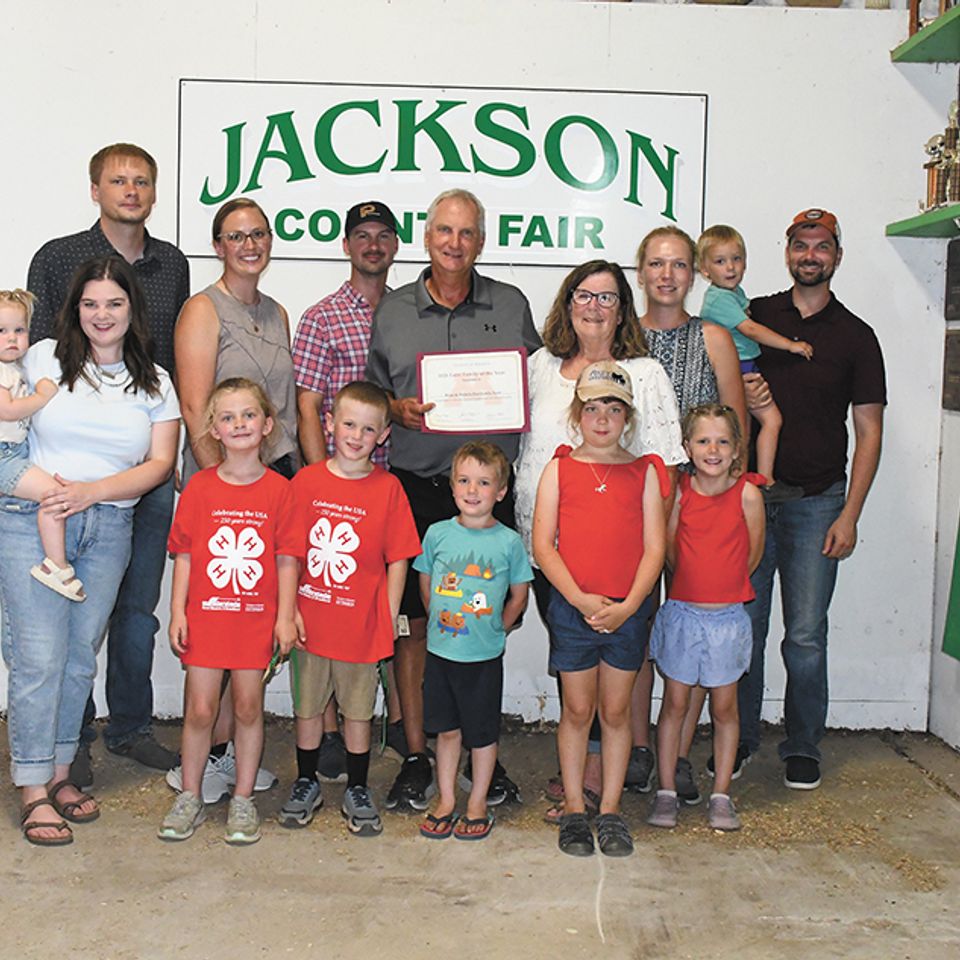
Earlier this year, the Brian and Kim Fruechte family was named the Lincoln County Farm Family of the Year.

“It’s a nice honor, of course,” Fruechte said. “It’s very nice to have them think about you that way.”
The family lives on a farm near Verdi that once belonged to Fruechte’s great-grandparents, John and Ora Fruechte, who kept bees at the farm site. Fruechte said there’s still a “honey shed” at the farm that was used by his great-grandparents.
His grandparents, David and Donna, moved to the site later and started farming, primarily raising cattle. Fruechte said it was his grandfather, David, who gave he and Kim the opportunity to get started in farming.

They both graduated from Pipestone High School and then went to South Dakota State University. After college they got married and moved to Sioux Falls for a couple years before making their way back to the farm.

“Even before we were back, he [David] started renting us a little bit of land here and there and very much eased us into it,” Fruechte said. “That was actually kind of a blessing in disguise, just going super slow into it even though we were probably anxious to get going for a while there. It helped us to probably get a little better at farming. The mistakes we made were small instead of big and that was nice.”

Today, the Fruechtes grow mostly corn and soybeans and a little bit of small grains. They also have sheep and they used to raise cattle. Fuechte said that when they got rid of the cattle they increased the number of sheep and had a decent size commercial sheep flock for a while. They’ve since transitioned to raising club lambs for kids to show, including their own.

“I think it’s a good youth development kind of activity,” Fruechte said.

In addition to their farming operation, the Fruechtes do some planting and combining for his dad, Mike, and brothers, Tyler and Justin. Fruechte also sells crop insurance through his business, Fruechte Crop Service, and sells Channel seed.
Fruechte said he and Kim both grew up farms in Pipestone County. He said he decided to continue farming thanks to the opportunity provided by his grandfather, and because he always enjoyed the work and liked that it allowed them to live and raise their children in a rural community.

“I think small town America is pretty important,” he said.

The Fruechtes have four children, ages 10 to 17, and he’s hopeful that at least one of them will choose to continue farming.

Aside from farming and other work, Fruechte is involved in the University of Minnesota Extension Committee and the Corn and Soybean Growers at the county and state levels, and Kim is involved in the Farm Bureau at the county level. The family is also involved in Faith Community Church in Pipestone, 4-H, sheep showing and wrestling.
Mackenthun ryan mug1
Mackenthun a
program proponent
Brownton farmer Ryan Mackenthun is a big fan of the American Soybean Association and Corteva Agriscience Young Leader Program.

After all, he’s a graduate of the 2019-2020 cohort.
The ASA and Corteva Agriscience Young Leader Program has sought to identify and train soybean farmers to be leaders in the industry for more than 40 years. The program — which focuses on leadership and communication, agriculture trends and information and the development of a strong and connected network — is open to soybean growers, both individuals and couples, who are young in leadership, not age.

As the first state affiliate of the ASA, the Minnesota Soybean Growers Association has developed dozens of leaders through the program and continues recruiting growers to represent Minnesota soybean farmers for the next generation. After completing the program, graduates have the opportunity to become full voting at-large MSGA directors for three years.
“The support MSGA shows for the Corteva Young Leader program is beyond amazing,” Mackenthun said.

Mackenthun, who currently serves as MSGA vice president, credits the ASA and Corteva Agriscience Young Leader Program for developing him as an industry leader.

“The Corteva Young Leader Program was a great experience,” Mackenthun said. “It gave me a very in-depth look at what being an active leader in various soybean associations looked like. Thanks to this program, I have peers in the agricultural community from across the U.S. and Canada that I chat with often to share farming practices.”

The ASA and Corteva are currently in the process of selecting members the 2025-2026 program cohort. ASA and Corteva will work with ASA’s 26 state affiliates and the Grain Farmers of Ontario to identify the top producers to represent their states as part of this program.

Phase I of the 2025-2026 program will take place Dec. 1-4 at Corteva’s Global Business Center in Johnston, Iowa. It continues Feb. 24-27, 2026, in San Antonio, Texas, in conjunction with the annual Commodity Classic Convention and Trade Show.